
A Port City With Heavy Gas Users
Hull is one of the busiest ports in the country, and its industry reflects that. Wind turbine blades are made at Alexandra Dock. Food is processed, frozen and packed. Healthcare products, chemicals, caravans and modular buildings are manufactured across the city and the neighbouring East Riding.
All of these use gas, often in large amounts. Commercial Gas Certificate installs, tests, purges, repairs and certifies the pipework and appliances that these businesses depend on.
Gas Safe RegisteredReg. No. 568617
Which Gas Services Do Hull Businesses Ask Us For?
- Tightness testing after alterations, repairs and meter changes. See gas testing and purging.
- Purging into and out of service, with nitrogen on larger pipework.
- Leak repairs and replacement of corroded or damaged pipework. See emergency gas repairs.
- New pipework for plant, ovens, boilers and heaters. See commercial gas installation.
- Commissioning of new appliances, with settings recorded.
- Annual inspections and gas safety records. See commercial gas certificates.
Caravan, Modular Building and Large Shed Heating
The area is the centre of caravan and modular building manufacture in the UK. Production takes place in very large sheds, often with paint, cure and drying processes alongside.
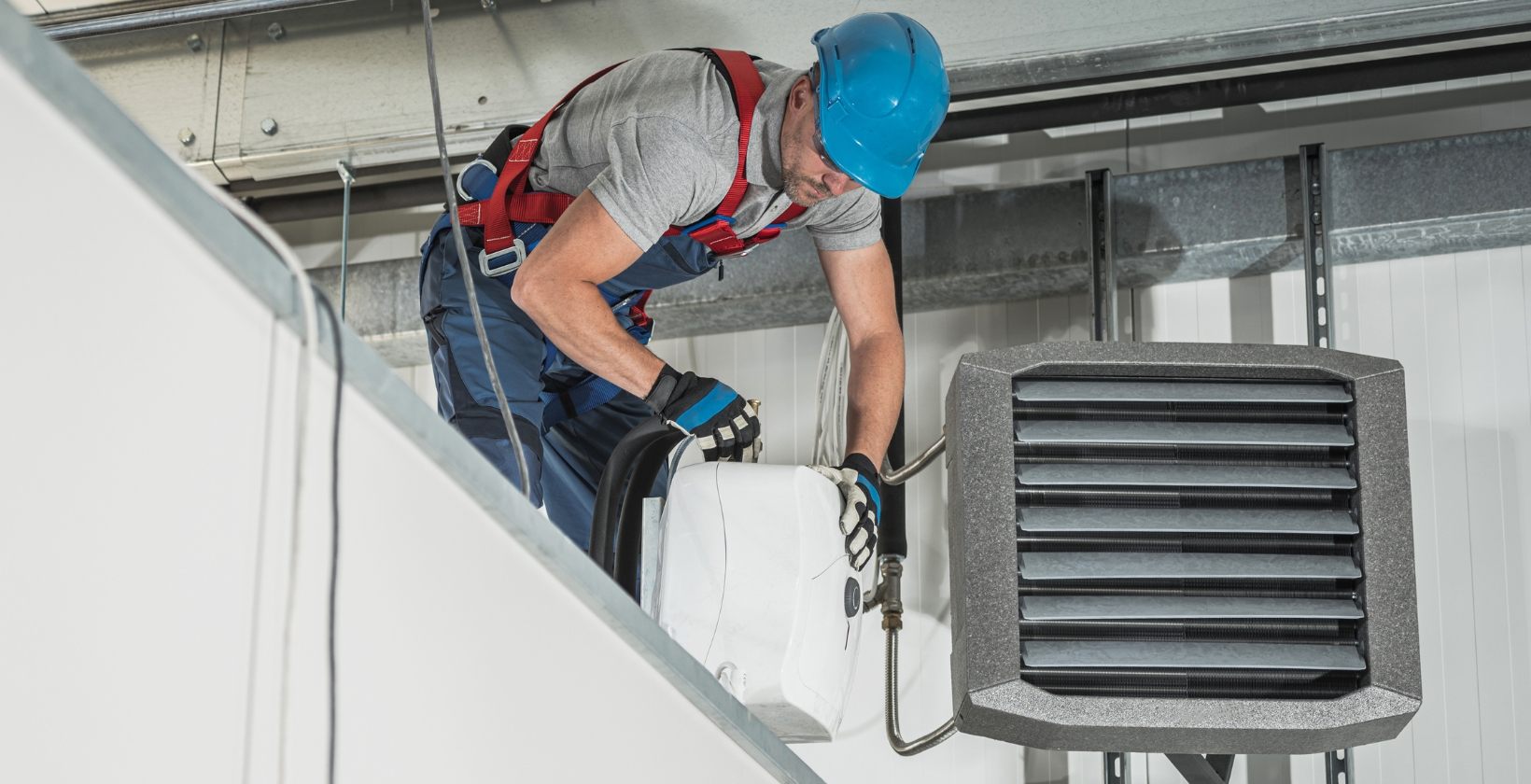
Heating a building of that size is a gas job in itself. Radiant tube and warm air heaters are mounted at high level, fed by long steel runs. We install, test and commission these systems and inspect them each year. See commercial heating systems.
Food Processing, Cold Stores and Steam
Food has been processed in Hull for generations, and the sector is still a major employer. Steam boilers, ovens, fryers and wash down hot water all run on gas, and production rarely stops.
We plan work around hygiene rules and production schedules. Alterations are tested and purged in a single visit where possible, and records are issued quickly so that your own audits are not held up.
How Do Tightness Testing and Purging Fit Together?
They are two halves of one job. Testing proves the pipework is sound. Purging makes it safe to use.
First the section is isolated and pressurised. After a settling period, the pressure is monitored for a set time, following IGEM/UP/1 or IGEM/UP/1A. If it holds, the pipework passes. New pipework has a strength test before this.
Then the air is purged out and replaced with gas, with readings taken at an outdoor vent until the purge is complete. On large volumes, nitrogen goes in first so gas and air never mix. Both steps are recorded and signed.
Repairs: Finding and Fixing Gas Leaks
Most leaks we find are at joints, valves and appliance connections, or on external pipework that has corroded. Damp, salty air from the estuary does steel no favours.
We use gas detection equipment and sectional testing to narrow down the location. The repair is made, the section is retested and the system is purged before appliances are relit. If pipework is beyond repair, we quote for replacement.
A repair is not finished until it has been proved. That is why every repair we make ends with a tightness test and a written record.
Port, Dockside and Chemical Sites
Sites on the docks, along Hedon Road and at Saltend have their own safety regimes. Work is controlled by permits, inductions and method statements, and areas may be classified for explosive atmospheres.
We are used to working within those rules. Risk assessments, purge procedures and test records are prepared in the format your site requires.
Where work is close to live plant, we agree isolations with your operations team and keep the gas off for the shortest time we can.
You can read more about our full range of commercial gas services, including emergency gas repairs and commercial heating systems, or see the other areas we cover, such as Leeds and Sheffield. Commercial Gas Certificate works nationwide.
Old Town and Fruit Market Kitchens
The Old Town, the Fruit Market and the marina have become the centre of eating out in Hull, with more venues along Newland Avenue and Princes Avenue. Many are in old warehouses and listed buildings. We install and test kitchen pipework, fit gas interlocks to BS 6173 and carry out annual catering inspections. See commercial catering.
Buried Pipework in Low Lying Ground
Much of the city is flat, low lying and close to the water table. That affects buried gas supplies. Trenches may need support and pumping, and polyethylene pipe is preferred because it does not corrode. See underground gas pipework.
Before any excavation, existing services should be located and marked. Digging in a public road or footway needs a permit from the highway authority.
Commissioning New Plant and Retiring Old Supplies
New appliances are commissioned before use. We check pressures, set burners, take combustion readings and prove safety devices. When plant is removed, the redundant pipework is isolated, purged, capped and labelled, and the remaining live system is tested.
For Hull manufacturers adding new lines, we can commission in stages. Each oven or heater is brought into service as it is installed, without waiting for the whole project to finish.
Who Are the Local Authorities and Network Operator?
Northern Gas Networks runs the gas distribution network here and owns the pipework up to the emergency control valve. New connections and upgrades are arranged with the network or through your supplier.
Hull City Council is the highway authority inside the city boundary. East Riding of Yorkshire Council covers Hessle, Cottingham, Hedon, Beverley and the rest of the surrounding area.
Areas Served Beyond the City Boundary
We cover Hull and the whole HU postcode area, including Hessle, Anlaby, Willerby, Cottingham, Beverley, Hedon, Brough and Hornsea. Across the Humber Bridge we work in Barton, Scunthorpe, Immingham and Grimsby.
We also travel to Goole, Bridlington, York and the rest of the UK.
What About Emergencies?
If you smell gas, call the National Gas Emergency Service on 0800 111 999 first. Our emergency team then covers Hull and East Yorkshire 24/7 for the repair that follows.
Contact Our Commercial Gas Team
If you run a plant, a kitchen or a commercial building in Hull, contact Commercial Gas Certificate. We will talk through the testing, purging or repair you need and provide a free quote with no obligation.